
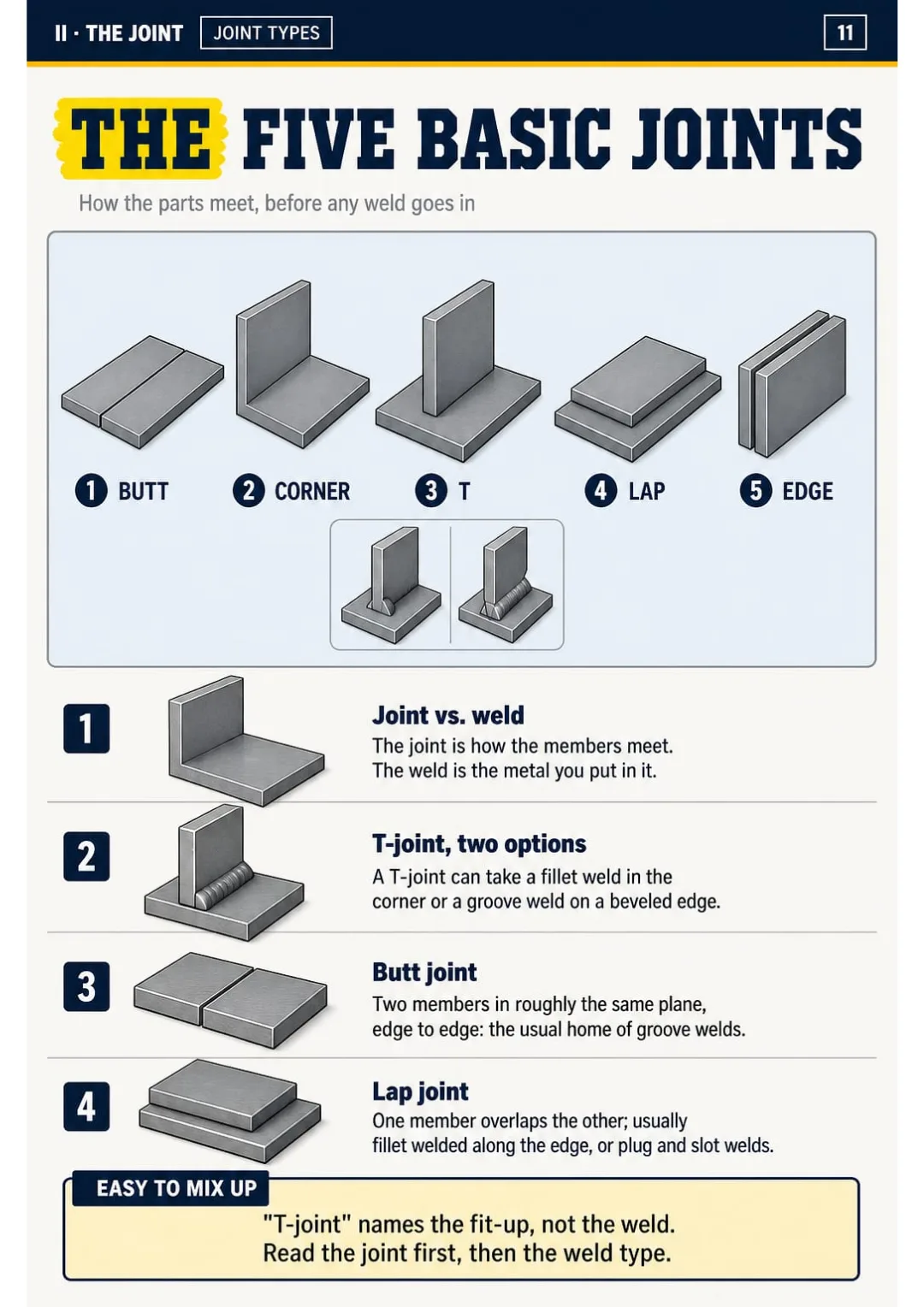
p. 11 · THE FIVE BASIC JOINTSEASY TO MIX UP
"T-joint" names the fit-up, not the weld. Read the joint first, then the weld type.
📄 Digital PDF book · read on your phone or print
Welding symbols, joints and positions, stick and MIG settings, joint prep and fit-up, undercut and porosity, bend tests and OSHA shade numbers. Open a topic and you see the joint, the symbol or the defect drawn large, with the one number or rule that matters and the code section it comes from. 57 pages in 9 parts.
Price US$ 27 US$ 63
🔒 Secure checkout · PDF by email · 30-day guarantee
The same topic, explained two ways.
It's your third week as a helper. The lead welder hands you a print: a flat line, an arrow bent toward the joint and a small fork at the end with letters in it. What is that symbol telling you to weld?
You could flip through the code book and land on a page with a dozen symbols stacked together, or ask the welder in the next bay. Two people, two answers, and the lead is waiting.
In the book, the symbol is one page. It breaks into three parts: the reference line, always horizontal, carries the instructions; the arrow points to the joint; the tail holds the process.
The rest works the same way: the five basic joints, polarity, cleaning the base metal, rod angles, undercut. Each one has its own page.
You read what each part does and the symbol becomes an instruction, not a picture.
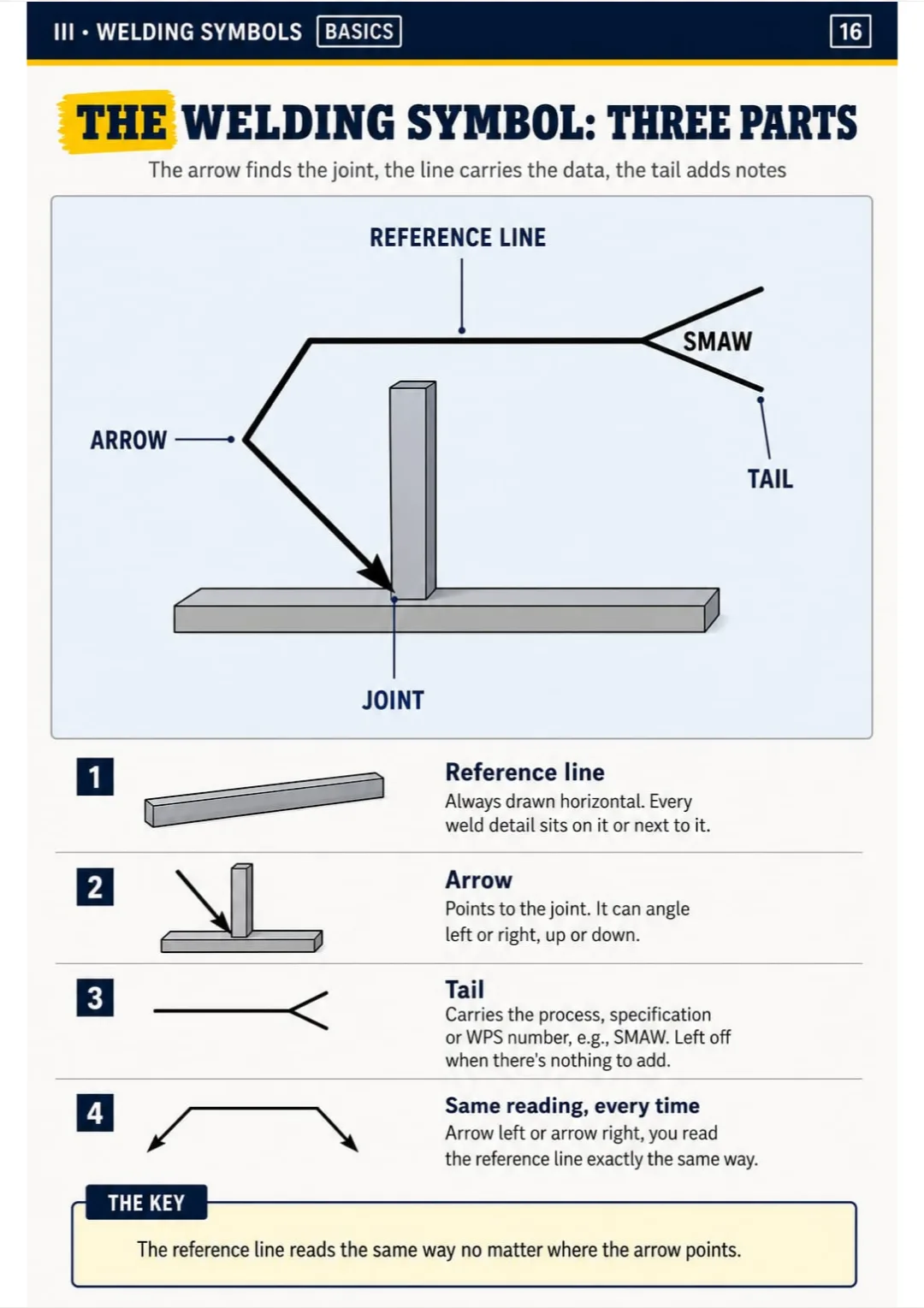
One big drawing per page, with a box of what to remember.
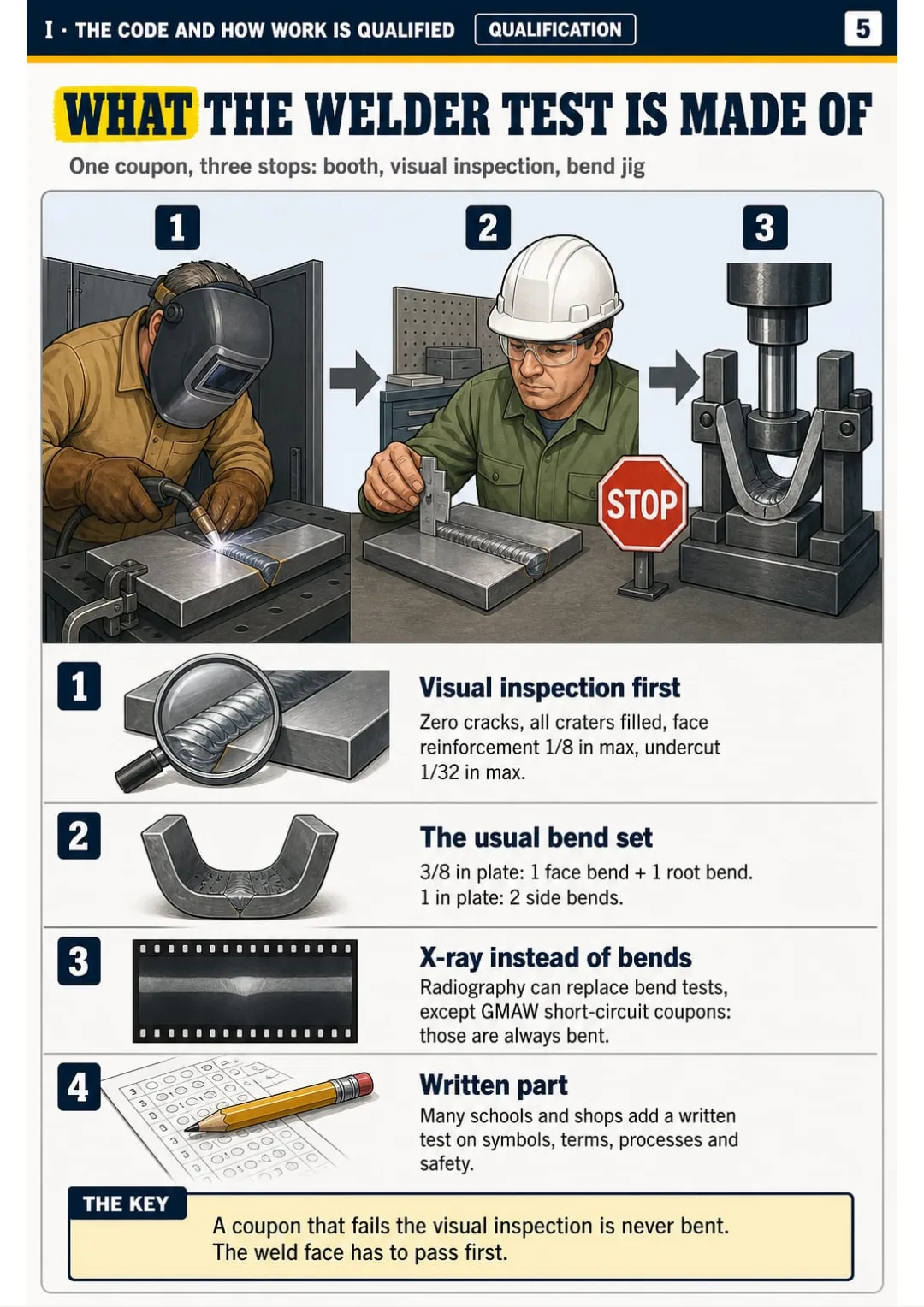
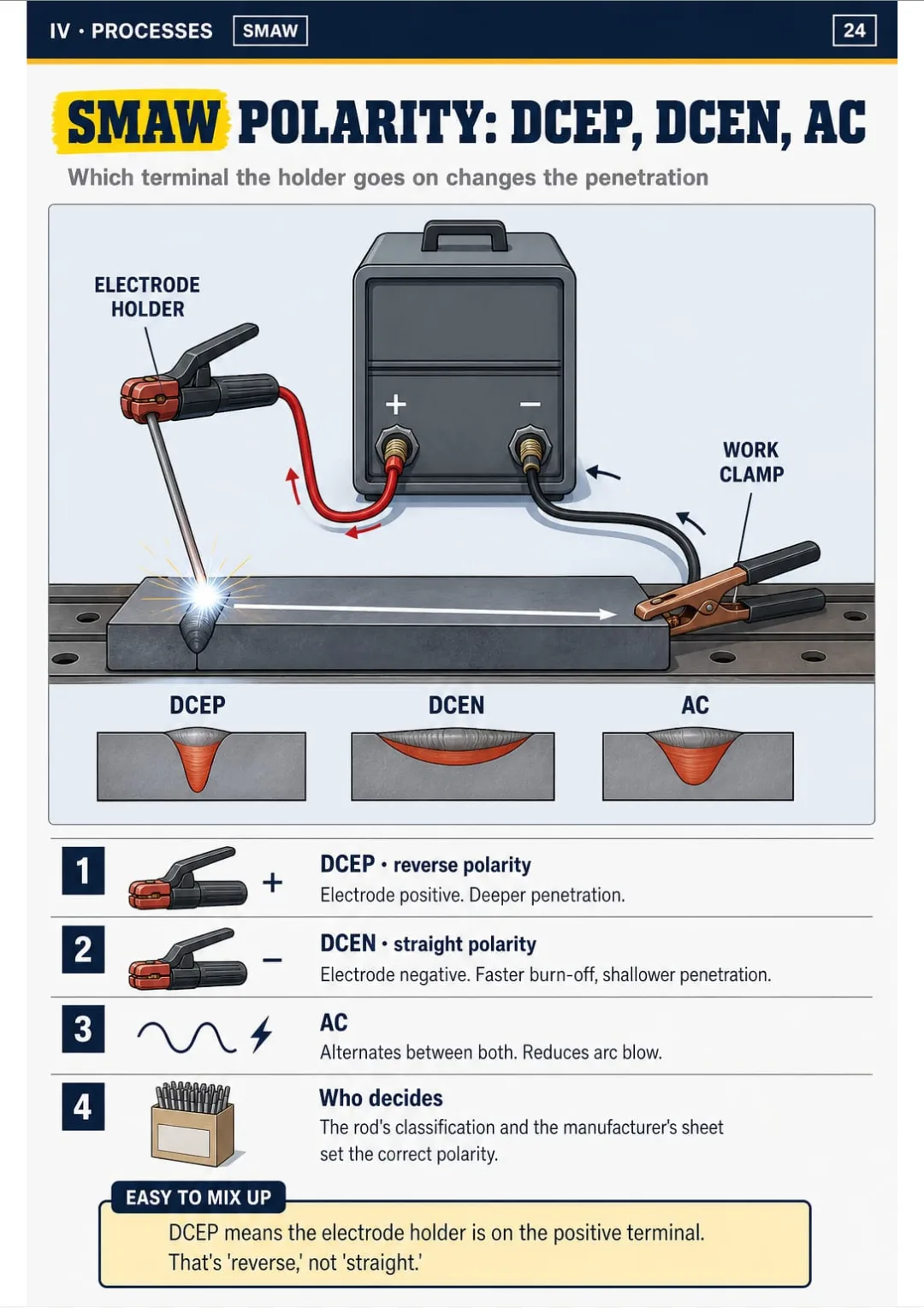
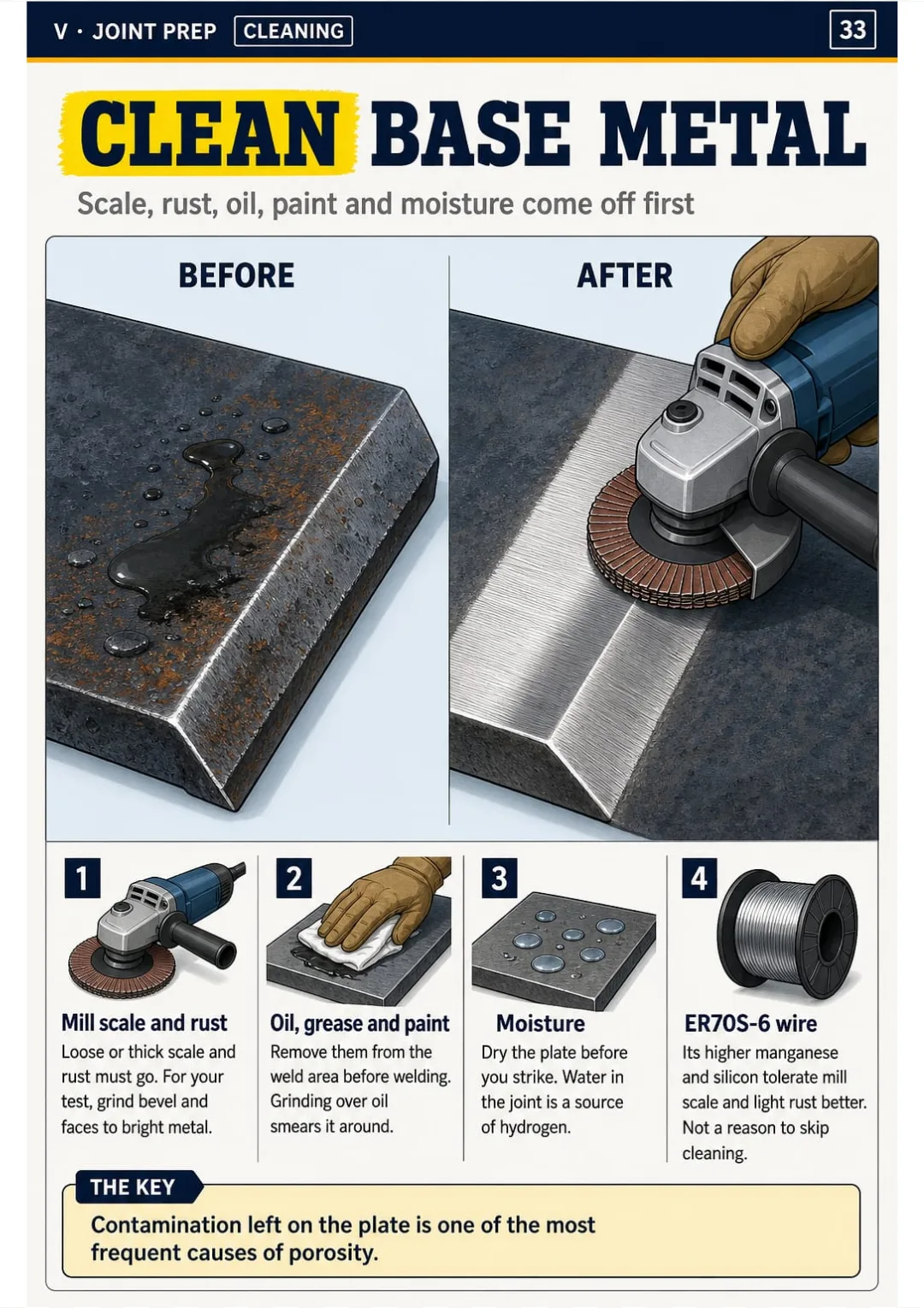
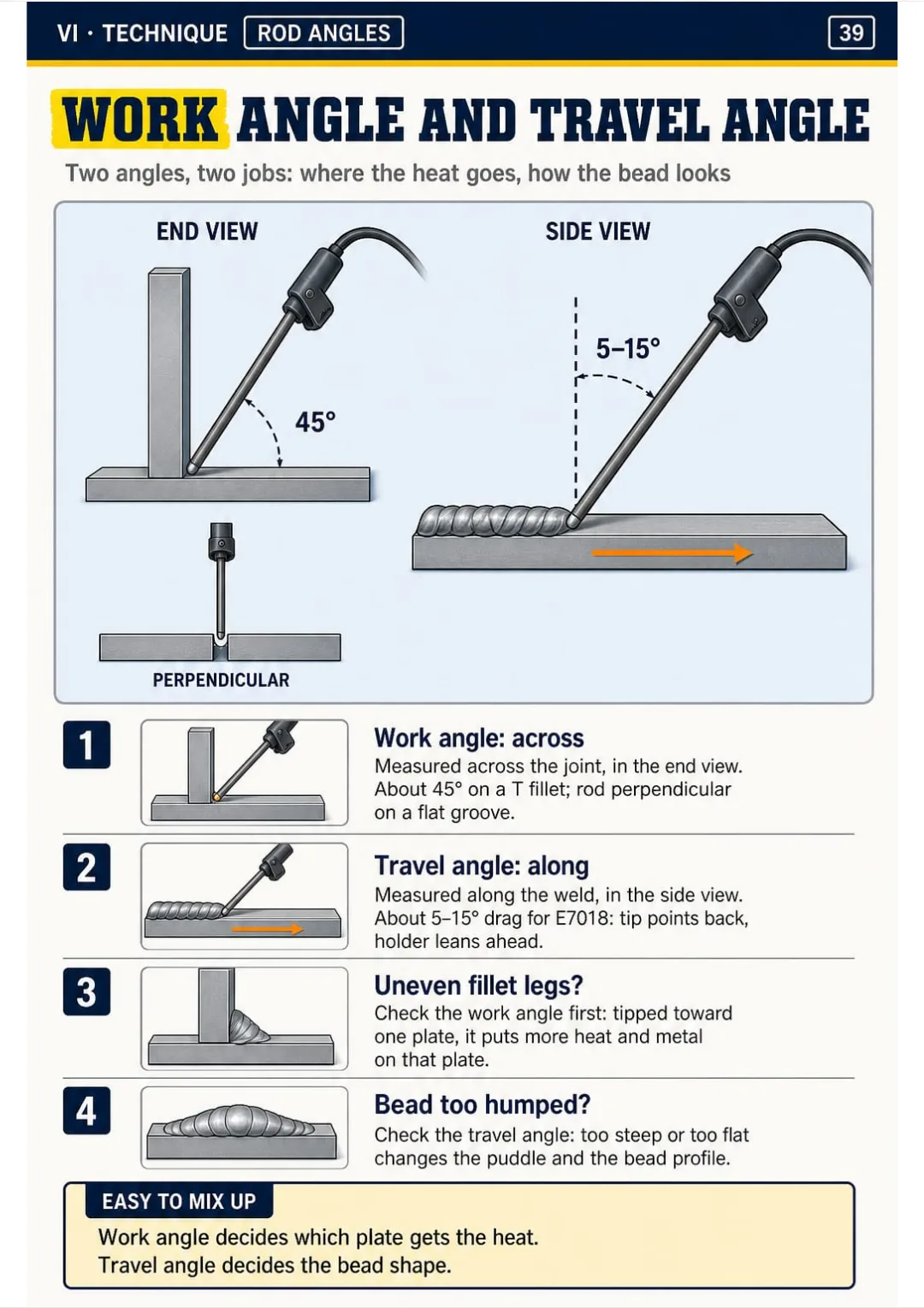
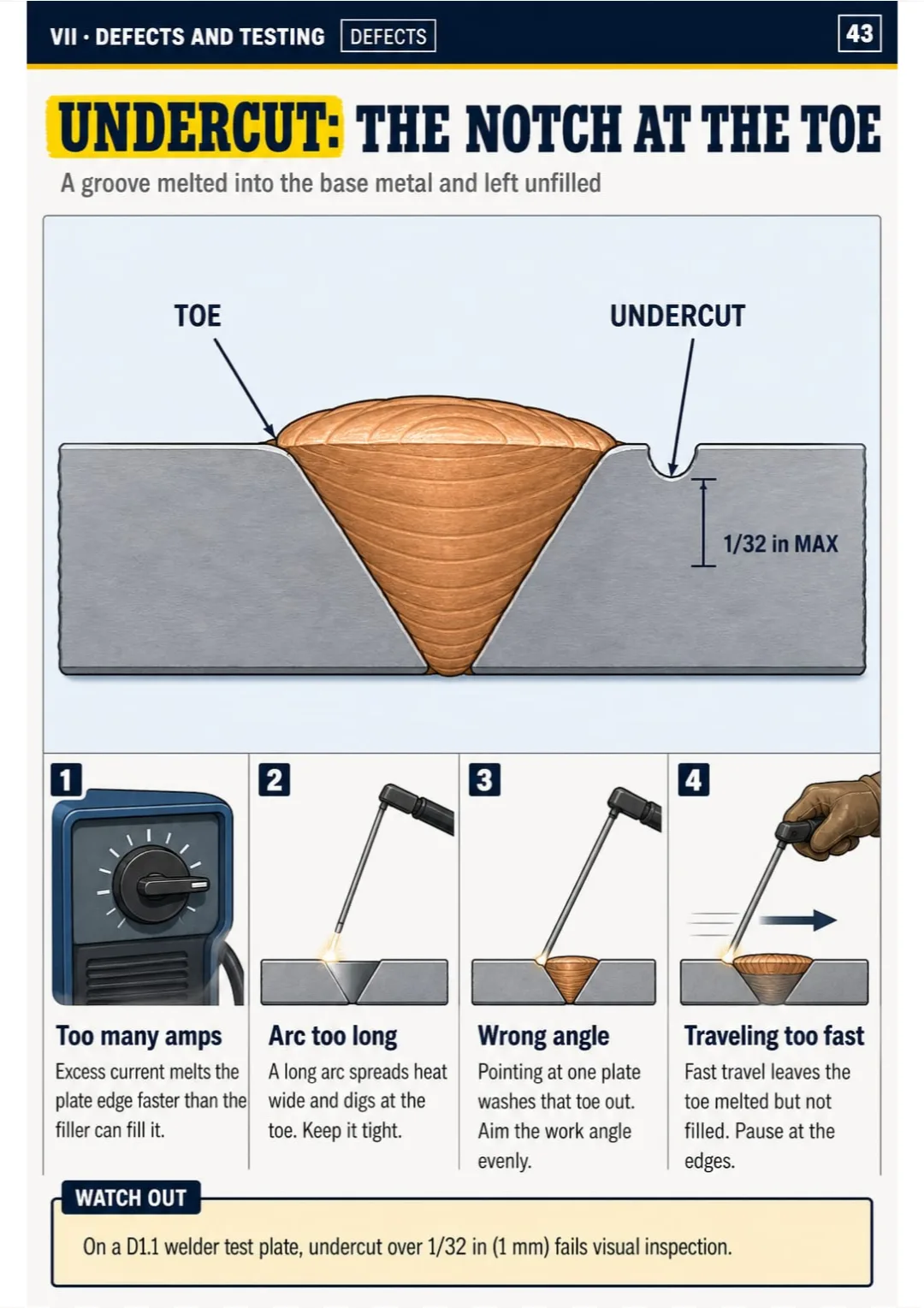
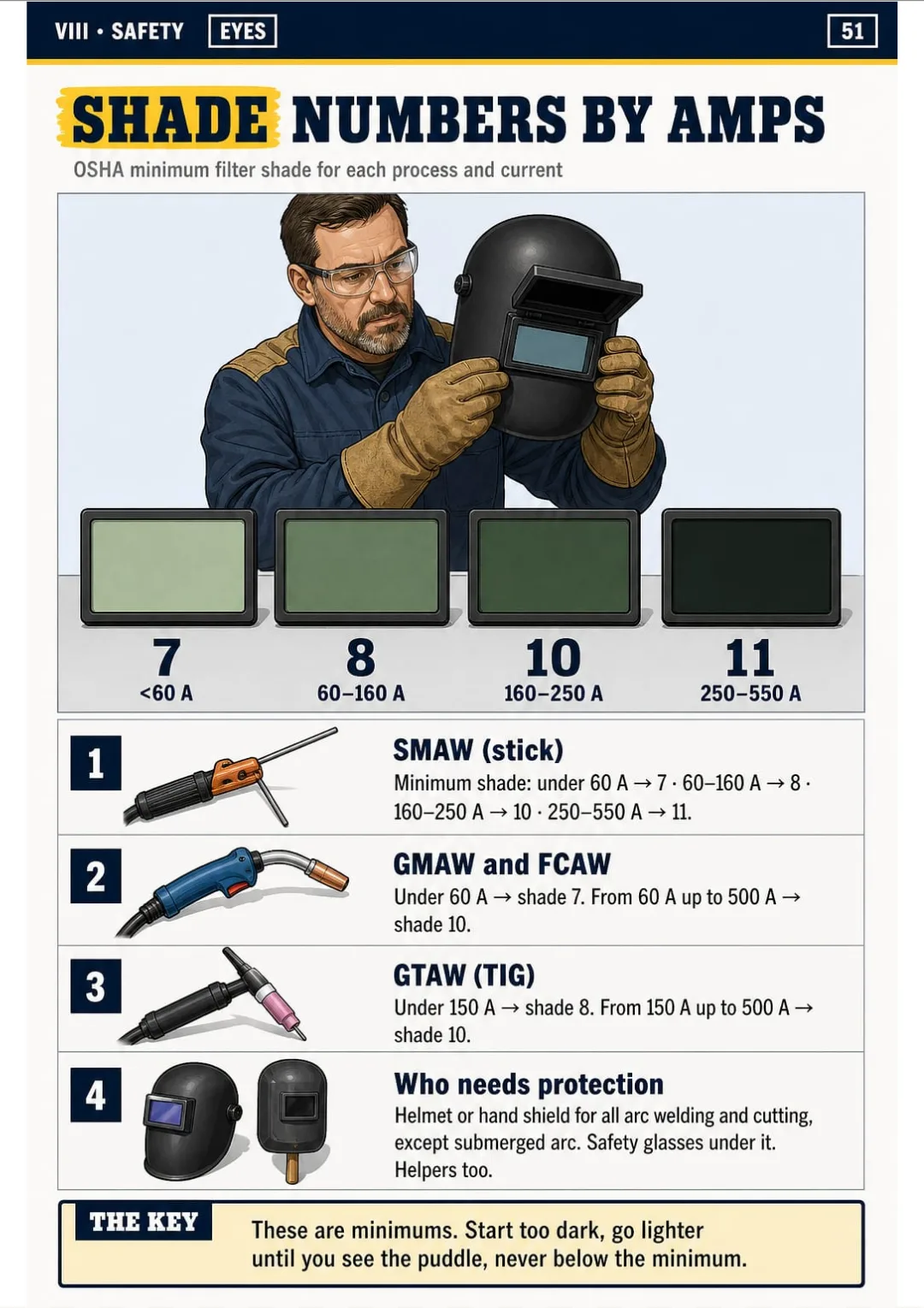
These are real pages from the book. The table of contents is the full one: 9 parts and 53 topics.
What the test is made of, who writes the code and who gives the test, WPS, PQR and WPQ, positions 1G to 4G and 1F to 4F, and how long your qualification lasts.
The five basic joints, the parts of a weld, fillet size and throat with the 0.707 rule, bevel angle vs. groove angle, and CJP vs. PJP.
Reference line, arrow and tail, arrow side vs. other side, fillet and groove dimensions, intermittent welds, supplementary symbols and finish letters.
Stick polarity, E7018 and E6010, low-hydrogen rod storage, MIG wire and gas, transfer modes, flux-core, heat input and arc blow.
Clean base metal, the test coupon, tacks, preheat, distortion control, the root pass, interpass cleaning and restarts.
Work angle and travel angle, vertical up in 3G, overhead in 4G, and stringer vs. weave with bead sequence.
Undercut, porosity, fusion vs. penetration, slag, cracks, overlap and reinforcement, plus what the inspector checks on visual and bend tests.
Shade numbers by amps, fumes and ventilation, fire watch, cylinders and oxy-fuel, and electrical shock, per OSHA.
A test-day checklist and one list of frequent mix-ups and key numbers.
At the end of the book: A THE KEY or EASY TO MIX UP box on most pages, plus a page of frequent mix-ups and key numbers
Price US$ 27 US$ 63
Every page ends with the mix-up that trips people up.
"T-joint" names the fit-up, not the weld. Read the joint first, then the weld type.
DCEP means the electrode holder is on the positive terminal. That's 'reverse,' not 'straight.'
Free with your book today.

Check yourself with questions in the style of the shop, and read why each answer is right or wrong so you understand it instead of just memorizing it.

Every basic welding symbol on one sheet, ready to print and keep at the bench so you can read a print without flipping through the book.
📄 This is a digital PDF book sent to your email: nothing is printed or shipped.
PDF by email: We email you Welder in Practice as a PDF, together with the two free books. It's a single payment: no installments, no extra charges.
Try Welder in Practice for 30 days, bonus books included.
We refund everything if the file won't open, if the book isn't what you see here, if you were charged twice or if the email doesn't arrive. Just email us.
You pay once. No subscriptions.
Pick the one that sounds like you.
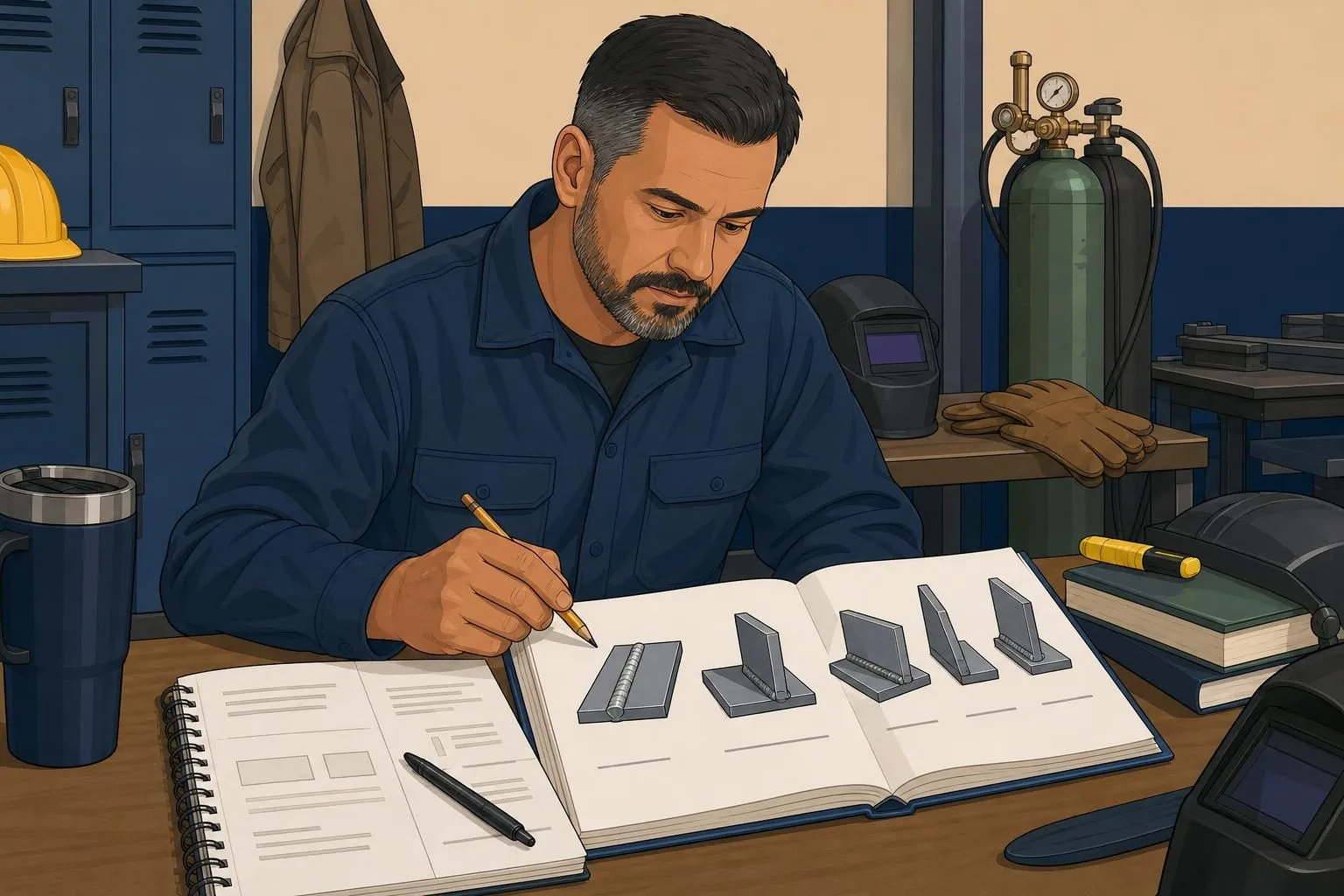
You watch the welders every day and nobody explains why they set the machine that way. Pages like polarity or work and travel angle put the reason on the page, next to the number.

You run good beads and want the reasons behind them. Pages like polarity or work and travel angle put numbers on what your hands already do.

You do fine at the bench, but the classroom terms blur together: butt or lap, bevel angle or groove angle. The five basic joints sit side by side with their names, so you can match the word to the joint you just tacked.
Quick answers before you decide.
Both. It starts with the joints, the symbols and how the code works, and every page keeps one drawing and one number. If you already weld, the pages put reasons behind what your hands already do, like polarity or work and travel angle.
It's a digital book, not a printed one. The book and the two bonuses arrive as PDFs by email, to read on your phone, tablet or computer, or to print.
Yes. You pay once and the files are yours, with no subscription.
No. It's study material that backs up your training, the code book and supervised practice. It doesn't give you a certification: that only comes from passing your test in front of the inspector. It won't run the plate for you, but it shows what the inspector looks at on visual and bend tests, and why defects happen.
Every key figure is checked against AWS D1.1 (current edition), AWS A2.4, AWS A3.0, OSHA 29 CFR 1910.133 and OSHA 29 CFR 1910 Subpart Q. Where a number can change with the edition or the employer, the page says 'per the current edition'.
The book covers the structural steel work under the AWS code and flags the figures that vary. Always confirm the exact limits with your WPS and your supervisor.
Yes. The PDF prints on regular letter paper, and the Welding Symbols Cheat Sheet is made to sit at the bench.
You have 30 days. We refund everything if the file won't open, if the book isn't what you see on this page, if you were charged twice or if the email doesn't arrive: just email us.
It's a PDF: read it on screen or print it
One book, one page per topic and 30 days to try it.
Start with the first page.
One-time payment: US$ 27 · Guarantee: 30 days · PDF by email
I want Welder in Practice for US$ 27📄 This is a digital PDF book sent to your email: nothing is printed or shipped.